
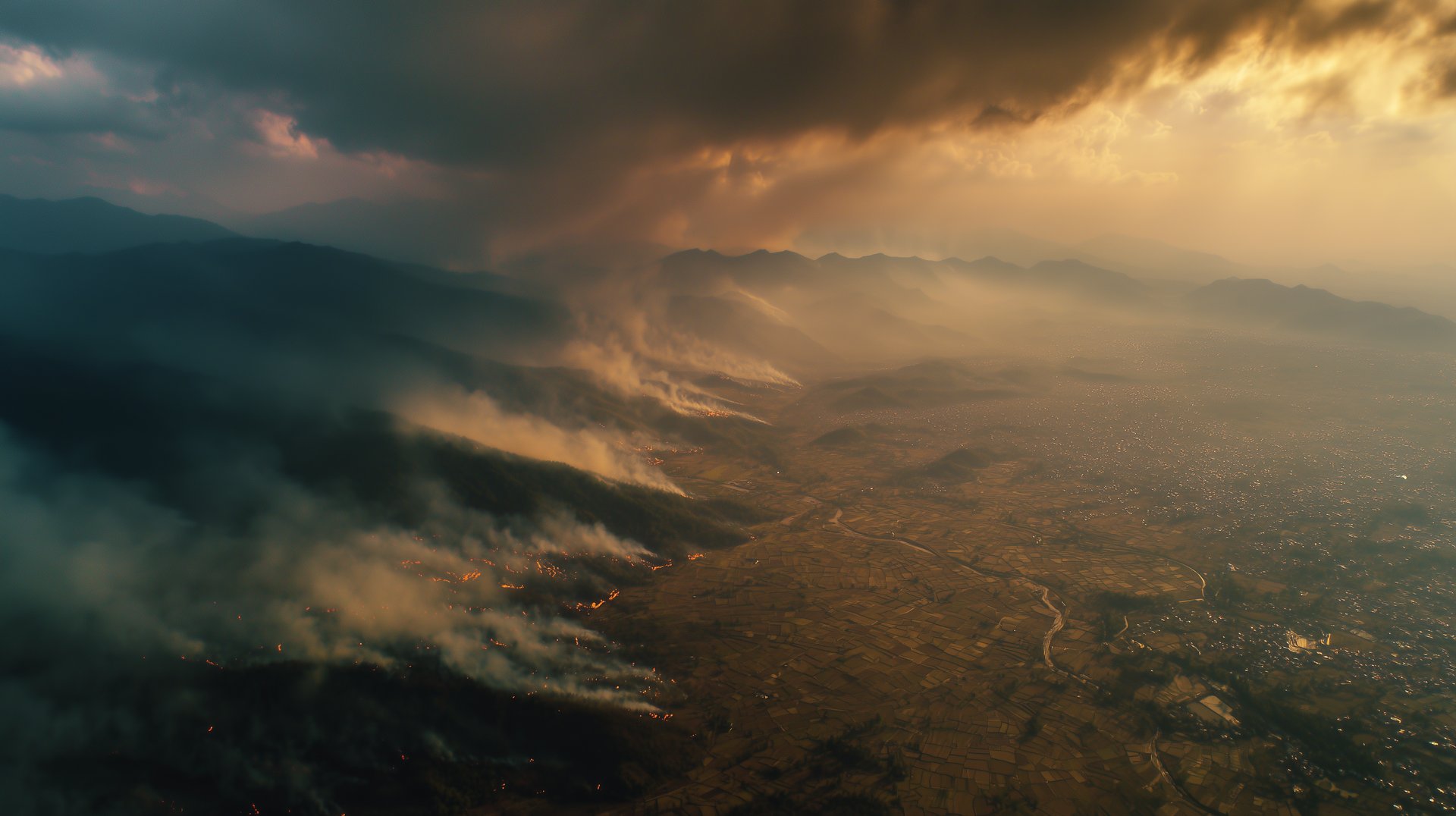
Nepal’s capital sits in a valley shaped like a bowl, beautiful to behold, but dangerous when the air turns toxic. Pollution settles here and lingers. What should move on, stays. What should disperse, thickens. And in recent years, Kathmandu has repeatedly recorded long stretches of unhealthy air, with severe spikes that place it among the world’s most polluted cities. This is not only a traffic story. Nor only a dust story. It is a burning story.
Each pre-monsoon season, smoke from forest fires across Nepal and the wider region drifts into the valley. At the same time, agricultural residue burning adds another layer of pollution to an already burdened sky. ICIMOD has warned that Kathmandu’s pre-monsoon air pollution is propelled by regional emissions and intensified by local meteorological conditions, while high pollution episodes are closely linked to forest-fire smoke and crop-residue burning. The result is air that enters the lungs but does not nourish them. Fine particulate matter, especially PM2.5, penetrates deep into the respiratory system and can enter the bloodstream. It is associated with respiratory disease, cardiovascular stress, stroke, diabetes, and premature death. These are not abstract risks. They are daily exposures carried by schoolchildren, traffic police, street vendors, the elderly, and anyone who simply steps outside.
In 2025, ICIMOD reported that Kathmandu’s residents had already endured unhealthy air on 75 of the first 90 days of the year. The same analysis tied the sharp deterioration to widespread pre-monsoon forest fires, especially during drought conditions. In parallel, regional initiatives have continued to identify agricultural residue burning as a major contributor to severe South Asian air pollution. And yet the paradox remains. Nepal is a country of wind, altitude, forests, and mountain light. The problem is not that we were given bad air. It is that we have allowed smoke, burning, dust, and neglect to overwhelm what should have been our greatest inheritance.
We speak often of development as though it lives only in roads, engines, and expansion. But no city is advancing when its people must negotiate each breath. The question is no longer whether the air is dangerous.
The question is how long a nation can thrive while slowly suffocating. Every. Single. Breath.
Between the first breath you take
and the last one before you fall asleep
your lungs have already paid the price.
Connect with us
MOOL is more than an organization—it is a growing movement of citizens, communities, educators, scientists, storytellers, entrepreneurs, and young people who believe Nepal's greatest wealth lies in the health of its rivers, forests, soil, air, and skies. If you share our conviction that a nation's future begins at its source, we invite you to connect with us. Whether you wish to volunteer, collaborate, support our initiatives, share an idea, or simply learn more, your voice and participation matter. Together, we can build a future where prosperity and nature thrive as one.
mool@mool.space
+977 9744305768